
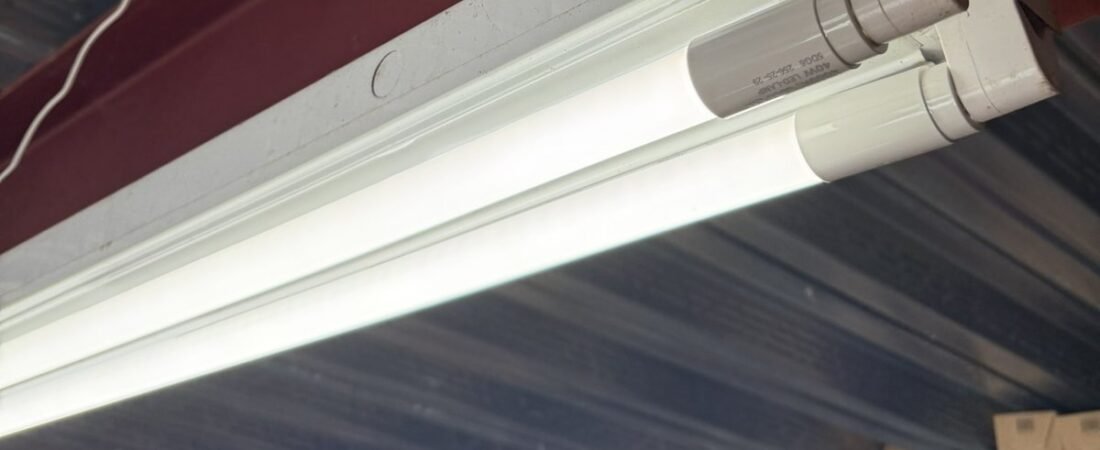
If your office, shop or warehouse still runs on older fluorescent tubes or metal halide fixtures, you’ve probably noticed the signs: tubes that flicker or burn out, ballasts that buzz, and light that never looks quite even. An LED lighting retrofit replaces that aging lighting with LED fixtures or LED conversions. Here’s what business owners and property managers in Catonsville, Ellicott City, Columbia and the rest of Baltimore and Howard County should know before getting started.
Why Businesses Switch to LED
LED lighting has become the standard choice for commercial spaces for a few practical reasons:
- Lower energy use: LEDs generally use less electricity than the fluorescent, halogen and metal halide fixtures they replace.
- Longer life: LED fixtures typically last much longer than fluorescent tubes, so you spend less time and money on replacements, especially in high ceilings and parking areas.
- Better light: LEDs come on instantly, don’t flicker the way failing tubes do, and are available in a range of brightness levels and color temperatures.
- Less heat: LEDs give off less heat than many older lamp types, which can make a difference in small offices and retail spaces.
How much you save depends on your building, the fixtures you have now, how many hours your lights run and your electric rate. A walkthrough of your space is the only honest way to size up a project.
Your Retrofit Options
There isn’t just one way to convert to LED. The right approach depends on the condition of your existing fixtures and how long you plan to stay in the space.
- Plug-and-play LED tubes: These work with the existing fluorescent ballast. They’re quick to install, but you’re still relying on that ballast, and when it fails, the tube goes dark.
- Ballast-bypass LED tubes: The ballast is removed and the fixture is rewired to feed the LED tubes directly. This takes the ballast out of the picture, but the fixture needs to be rewired and labeled correctly.
- LED retrofit kits: The inside of the existing fixture is replaced with an LED kit while the housing stays in the ceiling. This gives you a like-new fixture without tearing out ceiling tiles.
- New LED fixtures: Flat panels, troffers, high bays, wall packs and pole lights replace the old fixtures entirely. This is often the best choice when fixtures are worn out, or when you’re renovating anyway.
Many businesses end up with a mix, for example new flat panels in the office area and high-bay fixtures in the warehouse or back of house.
Don’t Forget Exterior and Parking Lot Lighting
Exterior lighting is often the first place businesses notice a difference. Older wall packs and parking lot lights tend to be hard to reach, expensive to re-lamp and slow to warm up. LED wall packs, canopy lights and pole fixtures can improve visibility for customers and employees after dark, and adding photocells or timers helps make sure the lights come on and go off when they should.
Before swapping exterior fixtures, it’s worth having an electrician check the circuits, connections and any underground wiring feeding them. Corroded connections and failing photocells are common causes of lights that won’t stay on.
Emergency and Exit Lighting Still Has to Work
A lighting retrofit is a good time to look at your emergency lighting. Many commercial spaces have exit signs and emergency fixtures with battery backup, and some regular fixtures have emergency ballasts or drivers built in. When fixtures are converted or replaced, that emergency function has to be kept or replaced so the space still has the lighting it needs during an outage.
We can check exit and emergency lighting as part of the job and replace older units with LED versions at the same time.
Lighting Controls and Code Requirements
Depending on the size and scope of the project, current energy codes may call for lighting controls such as occupancy sensors, daylight controls or automatic shutoff when lighting is altered. Controls can also simply make sense: there’s no reason to light an empty break room or storage area all day.
Many commercial lighting projects also need a permit and inspection. JJ Palmer Electrical Service is registered to pull electrical permits in both Baltimore County and Howard County, so we can tell you what your project needs and take care of that process.
Keeping Your Business Open During the Work
Nobody wants to close their doors for a lighting project. A little planning keeps disruption to a minimum:
- Work can be done in phases, one area at a time, so the rest of the space stays usable.
- Circuits are labeled and shut off only where work is being done.
- Materials are ordered and confirmed before the work starts, so fixtures aren’t left half-finished while waiting on parts.
We’ll talk through your hours and how your space is used before we set a schedule.
Why a Licensed Electrician Should Handle It
Commercial lighting circuits often run at higher voltages than household lighting, and ballast-bypass conversions and fixture replacements involve rewiring. Mistakes can lead to fixture failures, tripped breakers or shock and fire hazards. This is work for a licensed electrician, not a weekend project for staff or a general handyman.
A retrofit is also a good chance to catch other problems, like overloaded circuits, loose connections or damaged wiring above the ceiling.
Talk to JJ Palmer Electrical Service About Your Lighting
JJ Palmer Electrical Service handles residential and commercial electrical work throughout Catonsville, Ellicott City, Columbia and the surrounding areas of Baltimore County and Howard County. Owner John Palmer is a Maryland Statewide Master Electrician (#12441) and has worked in the electrical trade since 1978. See our electrical services for commercial work we do, including tenant fit-outs, emergency lighting and circuits for new equipment.
If you’re thinking about an LED lighting retrofit for your office, store or parking area, call us at (443) 986-1000, Monday through Friday, 9 to 5, or contact us online.